


Walt Disney World has refreshed its official website with a cleaner homepage and a simplified navigation experience, giving the resort’s digital front door a noticeably different look. As of August 21, the Walt Disney World website foregrounds core vacation-planning functions including resort hotels, tickets, park hours, special offers, dining, Lightning Lane information, and the My Disney Experience app.
Visually, the Walt Disney World website now leans toward a lighter, more translucent presentation. The aesthetic has similarities to the glass-like interface language Apple calls Liquid Glass, although Disney has not publicly characterized its redesign as an Apple-inspired product or identified Apple as a design partner. Apple describes Liquid Glass as a translucent material intended to bring greater focus to content and navigation.

Walt Disney World Website Puts Planning Front and Center
The redesigned homepage is built around getting guests toward a transaction or planning decision quickly. Disney’s official site currently places “Explore Resort Hotels” and “Get Tickets” prominently near the top, followed by park hours and a “Save with Special Offers” section.
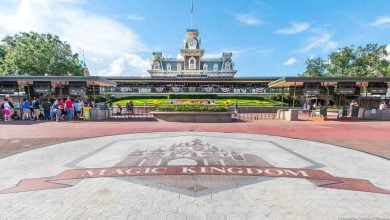
That streamlined presentation arrives while the physical Walt Disney World Resort is considerably more complicated. Inside the gates, Disney is simultaneously rebuilding or reworking substantial areas across multiple parks. Inside the Magic recently tracked 16 active Disney World construction projects, including projects capable of changing walkways, attraction availability, sightlines, and the overall guest experience.
The contrast is hard to miss: the website is becoming cleaner while parts of the destination are becoming construction-heavy.

A Cleaner Digital Disney World Meets a Resort in Transition
Magic Kingdom offers the clearest example. The Rivers of America, Tom Sawyer Island, and Liberty Square Riverboat permanently closed in July 2025 as Disney prepared the area for its next generation of development. Inside the Magic has documented both the draining of the Rivers of America and the continuing transformation of Frontierland.
That work is connected to Piston Peak National Park, the Cars-inspired expansion reshaping the former river area. Beyond it, Disney is also developing a Villains-themed land. The company has shared design details for the latter project, while Inside the Magic’s Villains Land coverage has followed how the expansion will alter Magic Kingdom’s western side.
Disney’s Animal Kingdom is undergoing another major transition. DinoLand U.S.A. closed in February 2026, clearing the way for Tropical Americas, also known as Pueblo Esperanza. Recent Tropical Americas construction progress shows that corner changing ahead of its planned 2027 debut.

The Website Redesign Creates a Striking Narrative Contrast
It would be tempting to call the Walt Disney World website redesign a deliberate distraction from closures and construction. There is no verified evidence supporting that conclusion, however, and Disney has not said the interface was created to redirect attention from disruption inside the parks.
What can be said is that the redesign creates a useful marketing contrast. A simplified digital experience removes friction from browsing hotels, tickets, dining, and offers at a moment when explaining the physical resort requires more context. Guests researching a trip may also need to understand which familiar experiences are gone, which areas are behind walls, and which future attractions have not opened yet.
Disney’s Hollywood Studios adds another layer. The former Muppet*Vision 3D area is being transformed for Monstropolis, and permits tied to the Monsters, Inc. project have illustrated the scale of the redevelopment.

Simplification Can Help Guests, but It Cannot Replace Trip Research
For vacationers, cleaner navigation is a practical improvement if it makes essential information easier to locate. The official Walt Disney World website remains the authoritative destination for current park hours, tickets, resort information, special offers, and planning tools, and guests should verify operational details there before traveling.
But a polished homepage is not a complete picture of what visitors will encounter after entering the parks. Construction can affect atmosphere and routing even when a park remains fully open. A guest choosing Magic Kingdom because of memories tied to Tom Sawyer Island, for example, needs different information than someone primarily interested in newer attractions.
That makes independent trip research especially important during a resort-wide development cycle. Disney’s digital presentation can make choosing and purchasing a vacation feel straightforward; the on-the-ground experience may still involve walls, altered pathways, removed attractions, and projects awaiting completion.

Disney’s Digital Front Door Is Changing Alongside the Parks
The Walt Disney World website update ultimately fits a resort that is changing on two fronts. Disney is refining how guests discover and plan vacations online while major capital projects continue transforming what those guests will physically see in Florida.
The new interface should not be treated as proof of a PR diversion. There is currently no sourced basis for assigning that motive. Still, its timing creates an unmistakable juxtaposition: Disney’s digital resort looks increasingly uncluttered while several real-world areas remain deep in transition.
For guests, the smartest approach is to use the streamlined site as a planning tool, not as a substitute for checking current conditions. As construction advances at Magic Kingdom, Disney’s Animal Kingdom, and Disney’s Hollywood Studios, the gap between today’s resort and Disney’s future version of Walt Disney World will remain an important part of vacation planning.