


We talk a lot about food here. Festival booths, quick service hidden gems, the best place to grab a snack before rope drop.
That is our whole thing.
But every now and then something happens in the Disney world that is bigger than what is on the menu, and this is one of those moments. Because while we were busy debating whether the new EPCOT festival booth was worth the wait, Disney’s annual shareholder meeting on March 18 got genuinely tense.
New CEO Josh D’Amaro was asked directly about the Disability Access Service program — the accessibility tool that for many families with disabilities is not a nice-to-have, it is the entire reason a Disney vacation is possible at all. The program has been controversial since Disney overhauled it in 2024, and the fallout has never fully quieted down. Shareholders voted on a formal proposal about it. D’Amaro had to answer for it on the record. And the outcome of that meeting tells you a lot about where Disney stands right now on one of the most significant guest experience debates the company has faced in years. We broke it all down.
So What Actually Is DAS and Why Is Everyone Upset

Quick background for anyone who needs it, because this matters.
The Disability Access Service lets guests who cannot tolerate extended waits in a conventional queue book return times for attractions through the My Disney Experience or Disneyland app. Instead of standing in a standby line for an hour, they can go shop, eat, or ride something with a shorter wait, then come back during their window. For guests with disabilities that make long queue waits genuinely impossible, this is not a perk. It is what makes the park accessible.
In 2024, Disney significantly tightened who qualifies. The updated criteria limited DAS to guests with a “developmental disability like autism or similar” who cannot wait in conventional queues. That language knocked out a large portion of guests with physical disabilities who had previously relied on the program.
Disney’s reasoning was not entirely without merit. When the company replaced free FastPasses with the paid Lightning Lane system — which can run over $100 per day for a family of four on top of park tickets — DAS became a lot more attractive to people who were not necessarily using it in good faith. Abuse of the program was a documented problem. But the way the crackdown played out left a lot of people feeling like they were being punished for other people’s behavior.
Reports came out of cast members telling denied guests to practice waiting in line at home. To rent wheelchairs. To re-enter a queue by finding a family member already waiting — a suggestion that is logistically messy in a packed theme park and completely useless for solo visitors. Not a great look.
Disney has tweaked things since then, extending the validity period and clarifying the video call process with third-party medical reviewers. But the core eligibility restrictions? Still in place.
What D’Amaro Actually Said on the Record
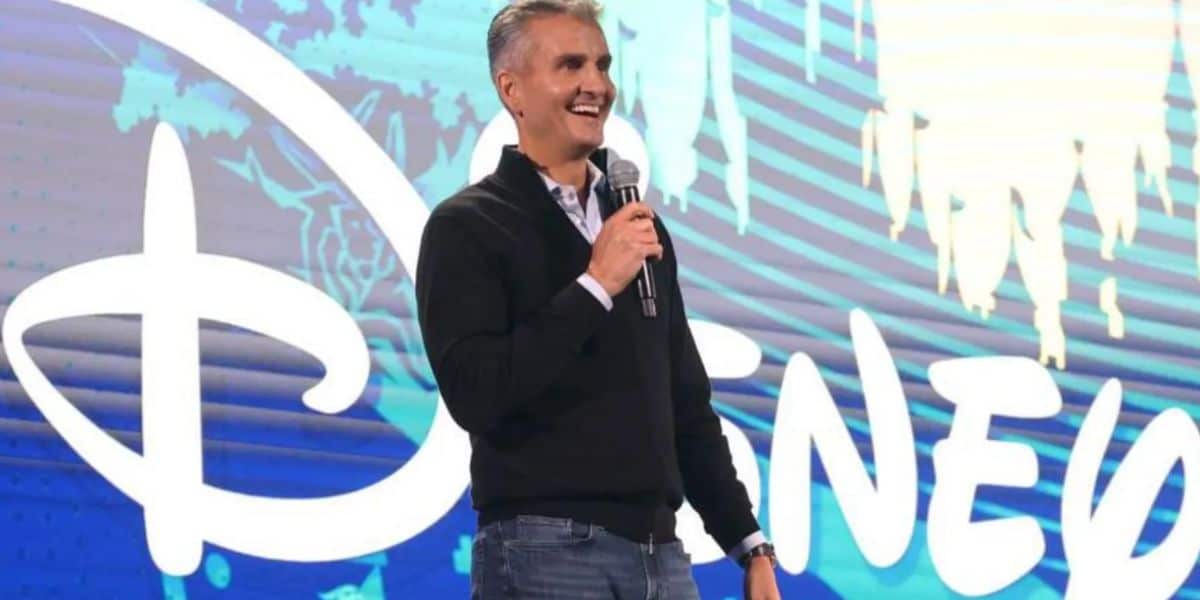
Near the end of the shareholder meeting, someone asked whether Disney would consider restructuring DAS to make sure it actually reaches everyone who needs it. It was a direct question. D’Amaro gave a carefully worded answer.
He started with the human stakes: “Accessibility is deeply personal and for many families, our services for guests with disabilities, they make it possible to enjoy our parks together.” He followed up with: “Creating a welcoming and inclusive environment for all guests, especially those with disabilities — it’s foundational to who we are.”
On the current program, he defended it: “It reflects really extensive work that we’ve done with accessibility experts and medical professionals, all in an effort to better understand individual needs and then really thoughtfully match guests with the right levels of support.”
He also pushed the individual conversation angle: “It’s important to us that we have individual conversations with families, and that we have a broad range of accommodations that our cast members can recommend through these individual conversations.”
And then he left the door cracked just slightly: “As we look ahead, as we always do, we’ll continue to listen, we’ll learn and apply expert guidance as we evaluate these accommodations over time, and we’ll always be focused on providing great experiences and designing these services to support our guests.”
Here is the part worth paying attention to. D’Amaro was the Chairperson of Disney Experiences when these changes were made. This is not a new CEO stepping into a mess someone else left behind. He built this policy. He is now defending it as CEO. That context matters.
The Shareholder Proposal That Got Voted Down
Disney shareholder Erik Paul pushed back formally with something called Proposal 7, officially titled “Review and Report on Disability Inclusion and Accessibility.” It asked Disney to bring in an independent third-party investigator to look at the DAS changes through the lens of legal, financial, reputational, and enterprise risk, then report the findings to shareholders. It did not demand Disney change a single thing. It just asked for transparency about the risks.
Paul’s argument was direct: “Accessibility policies influence brand trust, customer loyalty, regulatory exposure, guest safety, and repeat visitation. When policies are misaligned or inconsistently implemented, the resulting impact extends beyond guest experience to operational and reputational risk.”
Disney initially tried to get the SEC to let them exclude the resolution entirely, calling it “materially false and misleading.” A policy shift at the SEC made that unnecessary, and the vote went ahead — with Disney actively telling shareholders to vote no.
They did. By a lot. About five percent of shareholders voted yes on Proposal 7. It was not close.
And yes, there is an active class-action lawsuit filed in 2025 by a Disneyland guest over the DAS changes. That one is still working through the courts.
What This Means If You Have a Disney Trip Coming Up
If your family relies on DAS, nothing changed on March 18. The 2024 eligibility requirements are still in effect. You still need to qualify based on a developmental disability, complete a video call with a third-party medical reviewer, and reapply every twelve months.
D’Amaro’s “we will continue to listen” language is not nothing, but it is also not a promise. If someone in your group was eligible under the old DAS criteria and no longer qualifies, the most useful thing you can do before your trip is contact Disney’s accessibility services directly. D’Amaro mentioned that cast members can walk families through a broader range of accommodations in individual conversations, and that process exists regardless of DAS eligibility.
If the current program does cover your needs, it works as advertised. And if you are watching this situation from the outside, the lawsuit and D’Amaro’s stated openness to evaluation are the two things worth monitoring as 2026 moves forward.
We will be watching both. Obviously. That is also kind of our thing.
We will keep updating as the class-action lawsuit moves forward and as any new DAS guidance drops. In the meantime, if you are planning a Disney trip and working through accessibility questions, our full Disney Parks planning guide is on the site and covers everything currently available for guests who need accommodation support. Go read it, then come find us when you are ready to talk about what to eat.





Limit amount of times per day they can cut the line. ADA should not be able to ride 12 rides in 8 hours if my family can ride 3. Base it on park daily admission volume. Give an ADA family maybe 25% ride bonus compared to my 3 rides maybe they get a fourth. This way ADA Family’s wont increase the wait times for other guest that can’t afford fast pass or do spend money for fast pass but are only allowed a limit per day and I think 1 at a time now too!! This would improve all guests experiences more equitable to all guest who are spending a ton of money for their family to go to disney.
What most people don’t understand is that the DAS doesn’t “cut the line”. It is a placeholder in line. The time to come back to the line according to current wait time is arranged beforehand. When the waiting time is over it is time to get in line so it does look like a cut but it isn’t. People have waited outside of the line.
Well, here’s what isn’t fair. We can only go to Disney if we qualify for DAS, we cannot talk to a cast member to find out if we qualify until our tickets are purchased. This is a double edged sword. Anyone have any suggestions?
Who says they ride 12 ride in 8 hours? We certainly don’t as a DAS family. It’s not like rides are stacked. We always get the LL and DAS, and see lucky to knock out 5 rides. We need a lot of downtime which cuts into our day. Consider yourself blessed you don’t have to sit in front of a camera and have to explain some pretty personal reasons why a traditional line doesn’t work.
We would give anything to have a “normal” child.
Such a shame that the sleazy people who abused the system caused a change to a program that worked so well for so many years. Just as bad as people with imaginary “service animals” that will eventually cause difficulties for those with certified animals. The only solution is medical certification and another layer of administrative review to prevent abuse that Disney is unlikely to spring for
Universal has a certification from your personal doctor. You fill everything out online and, I believe, they contact your doctor. I looked into it but went for 7 days with my husband, so was able to break up my days with rest. Their lanes accomodate wheelchairs and scooters, etc.
Why does Disney refuse to use IBCCES? It’s used by multiple parks and would allow both ASD guests and guests with other disabilities to access DAS.
There are so many insensitive people in this world. Who cares if a family with disabilities rides more rides. Even though they probably do not. It is a place holder. Most families that have a disabled member cannot even last in the park for more than 4-5 hours. Unfortunately my father can’t afford to take my disabled sister but he gets looks from people wherever he takes her. Grocery store, churches. Etc. Because of her inappropriate laughing or talking to herself. Be happy if you don’t have to live like that on a daily basis. Be happy for those who have hard lives to get a little bit more peace in an already hard day.
What Disney needs to do is go back to the old FREE system of fast passes where everyone just got a scheduled time and came back with minimal wait. That way no one wins be tempted to scam the disability passes to do it for free. Then we’d only have to deal with the scammers who rent a wheel chair for their “disabled party” but sometime different is riding in it every time your pad them. But that would entail Disney back up on their corporate greed which will never happen. The more stupid people continue to pay for their greed, the more their greed ed will ask of them
My issue is less with the Disney cast on the DAS interview- they’ve been nice, helpful, and understanding. It’s the “medical professional” we get transferred to who makes the decision. On our last attempt, the “medical professional” was curt, barely asked any questions and immediately denied us and disconnected. The Disney cast member left on the line was stunned and all but said she didn’t agree and didn’t understand why my daughter was denied. She was able to reach her leaders to get us a little bit of magic to help, and encouraged us to reach back through the chat during our trip to let them know how the alternate accommodations were helping or hurting. She genuinely seemed disappointed we were denied.